Global Risk Analytics Platform
Scaling Risk Analytics for a Fortune 100 Financial Institution
Overview
The Global Risk Analytics platform had stalled as it attempted to scale. Data was difficult to interpret, workflows were fragmented, and the experience relied on manual CSS and non-standardized components.
As the platform expanded to support more than double the number of Lines of Business, these issues compounded, creating risk in both usability and decision-making confidence.
I joined the project at a standstill and helped reestablish momentum by introducing scalable UX patterns, aligning stakeholders around a shared interaction model, and delivering interactive prototypes that guided implementation.
Unblocked a stalled initiative and enabled platform growth
A project that had seen little progress over three years was restructured and moved forward, supporting the expansion from a limited set of Lines of Business to a scalable, unified model.
Established scalable design patterns and reduced UX fragmentation
Introduced reusable components and standardized interaction patterns across eight core areas of the application, reducing reliance on manual CSS and enabling faster feature development
Improved clarity and usability of complex data workflows
Simplified filtering and navigation patterns, addressing conflicting behaviors and enabling users to better interpret system data and make decisions.
Influenced product direction through research and evaluation
Led usability testing and conducted a heuristic evaluation with engineering partners, identifying UX debt and shaping a prioritized backlog adopted by the team.
Delivered high-fidelity prototypes to drive alignment
Created pixel-accurate interactive prototypes used by stakeholders, including Director-level partners, to validate direction and guide development.
Challenges
Ambiguous ownership and stalled progress
Ownership across data visualization, UX, and the underlying data models was fragmented, especially during the integration of new business areas. I worked to establish clearer ownership boundaries and align stakeholders, helping resolve conflicting directions and restore forward progress across the platform.
Design-by-committee decision-making
Design decisions were shaped by multiple stakeholders without a shared framework for alignment or a consistent approach to UX. I introduced clearer structures for alignment and decision-making, reducing competing inputs and improving the team’s ability to move forward.
Scaling a system without a unified data model
As new Lines of Business were introduced, the platform lacked a consistent data structure and interaction model. I worked to define scalable patterns and align stakeholders around a unified approach, reducing fragmentation and enabling the system to grow without added complexity.
Scaling complexity across multiple data domains
The platform needed to support significantly more Lines of Business while maintaining clarity and consistency across workflows, data models, and visualizations.
Process
Across these efforts, I focused on moving the platform from fragmented interactions to a cohesive system that supports clear data interpretation and decision-making.
Resolving Conflicting Filter Behavior
Conflicting filter states required users to reset selections across pages
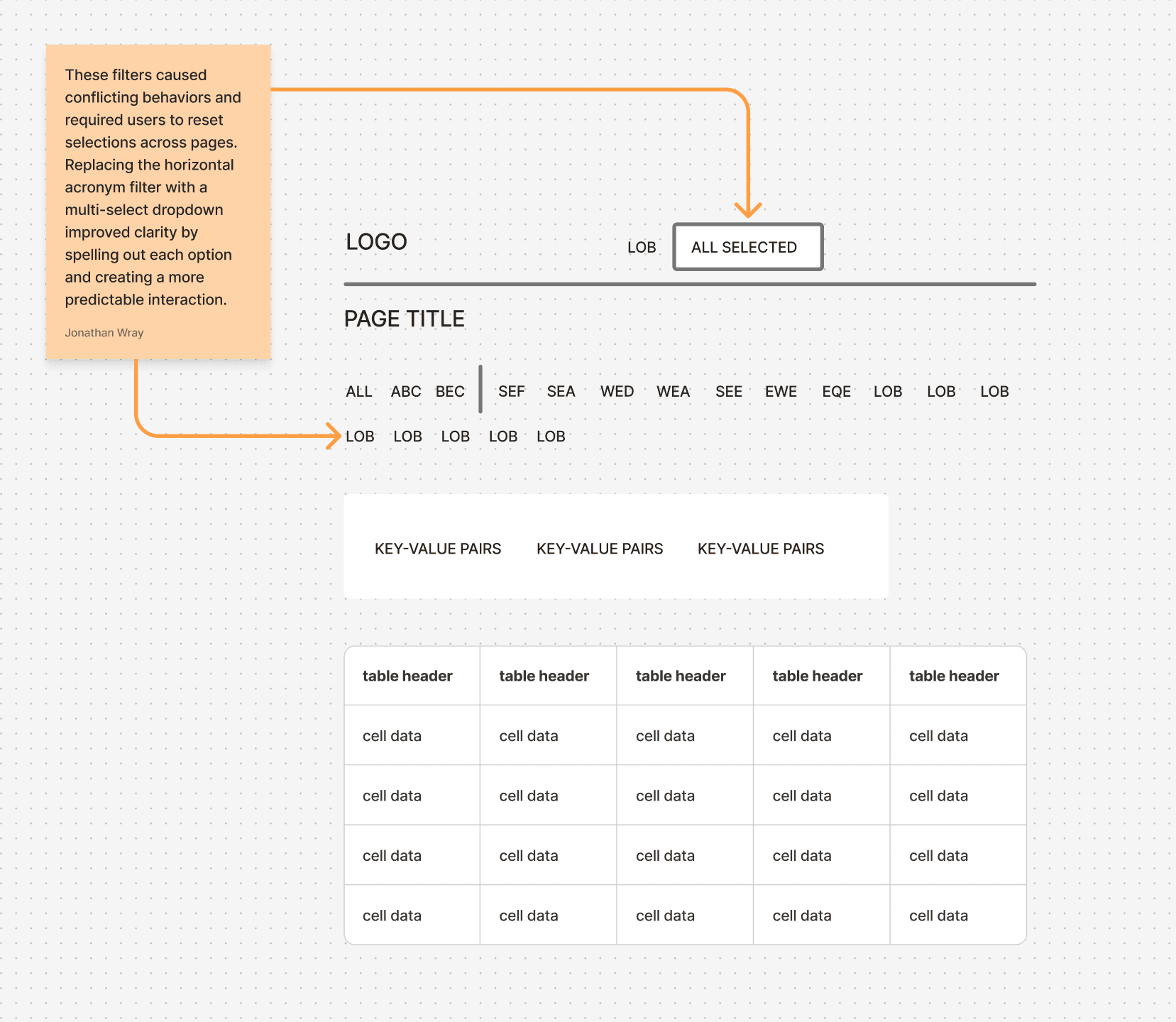
Identified conflicting filter states that required users to reset selections across pages
Reframed the interaction to prioritize clarity over dense, abbreviated inputs
Built and tested an interactive prototype to validate the new filtering model, aligning stakeholders around a clearer and more predictable interaction approach
Replaced horizontal acronym filters with a multi-select dropdown using expanded labels
Improved predictability by eliminating inconsistent filter states, removing the need for users to reset selections across workflows
Designing a Scalable Color System
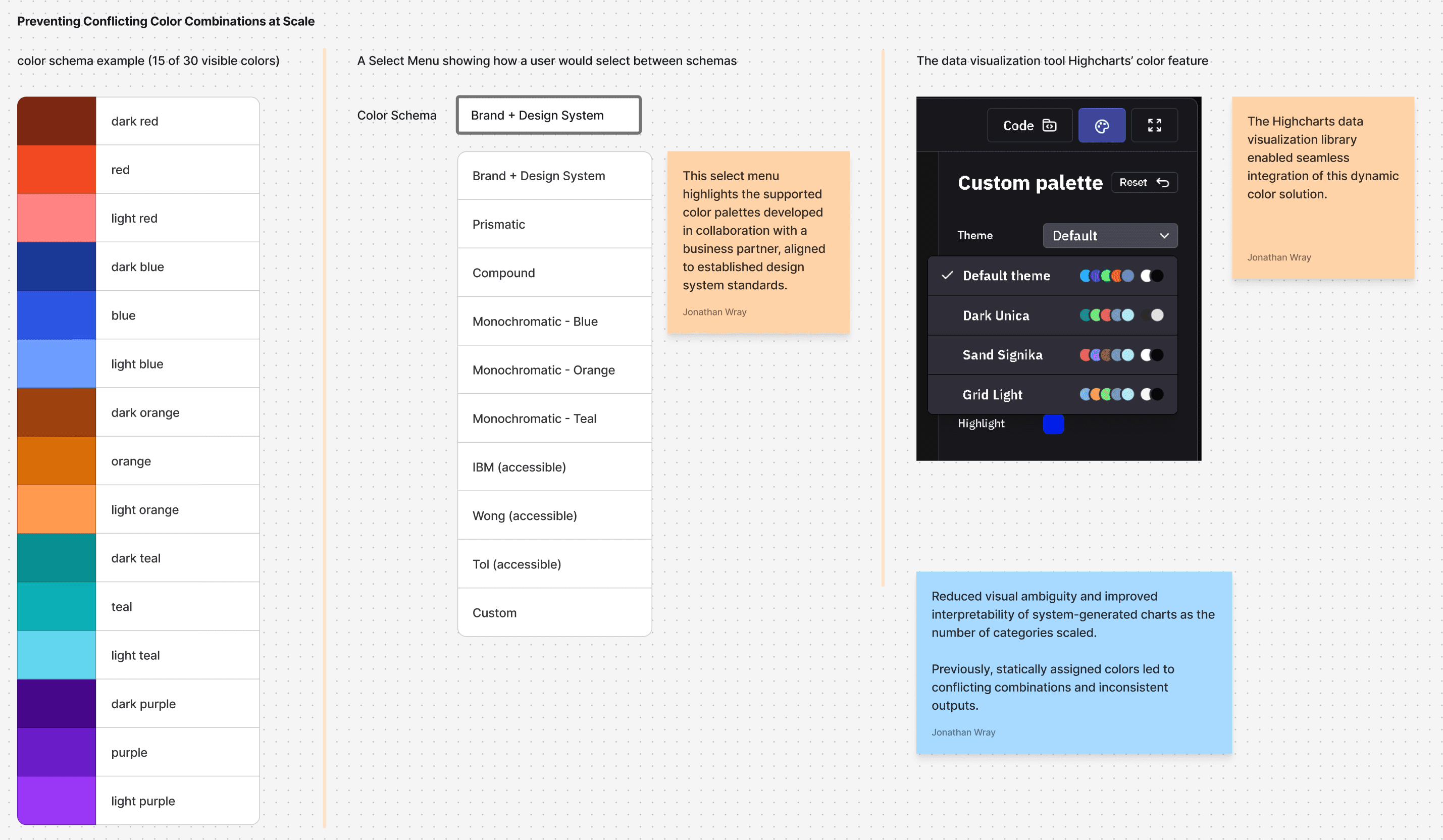
Observed breakdown of static color assignments at scale, leading to conflicting and inconsistent outputs
Shifted to a dynamic color system using predefined palettes aligned with design system standards
Defined palette structures to preserve contrast, hierarchy, and interpretability across data sets
Aligned implementation with Highcharts to support scalable, consistent system-generated visualizations
Structuring for Decision-Making in Complex Systems
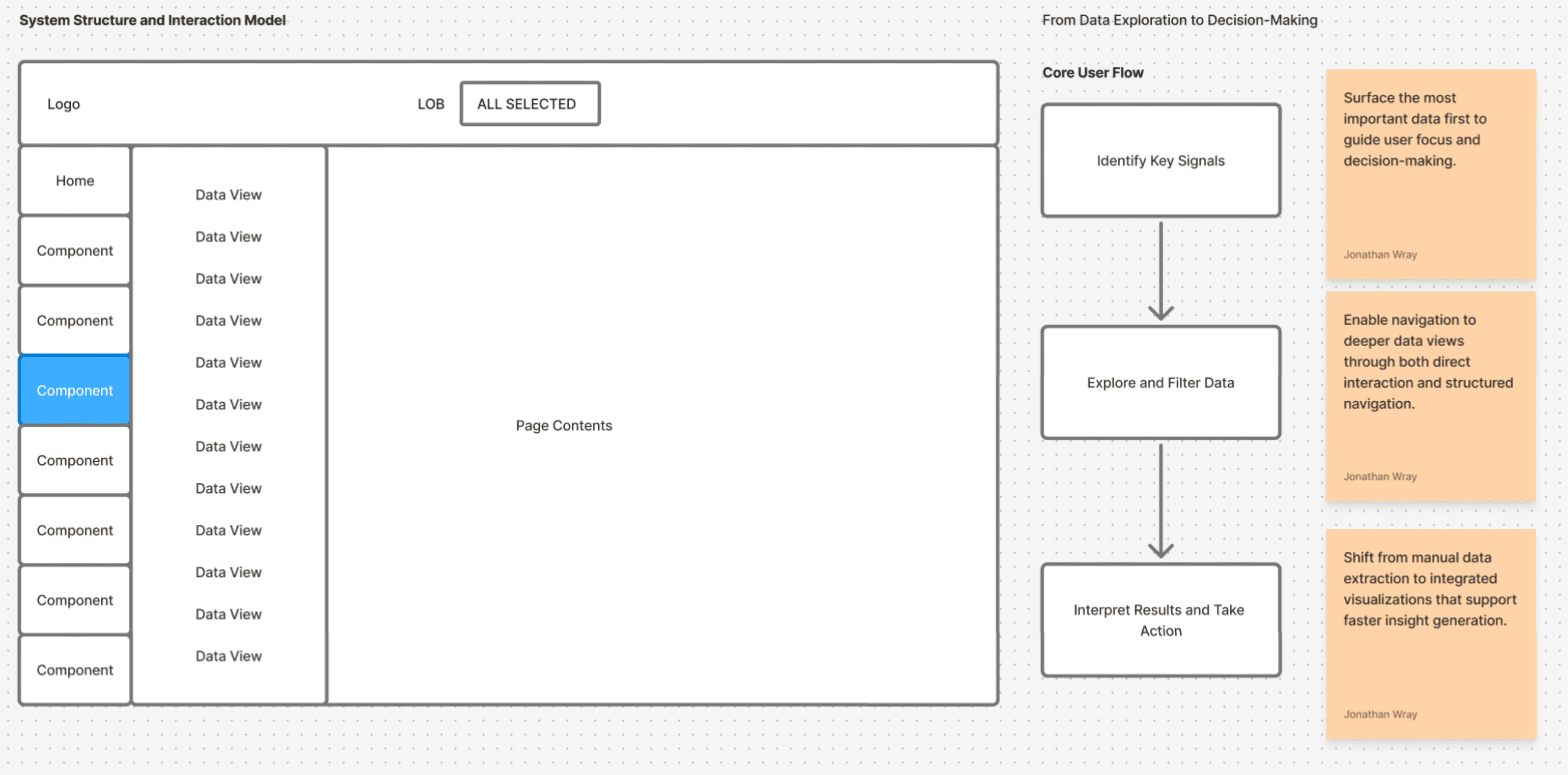
System structure and interaction model designed to support data interpretation and decision-making
Structured the experience to surface high-signal data early, enabling faster interpretation of system state and more focused decision-making
Established a navigation model between high-level summaries and detailed data views, enabling seamless movement from monitoring to investigation
Shifted workflows from manual data extraction to integrated, visualization-driven insights, reducing friction and enabling faster, more confident decision-making
Aligned stakeholders around a shared interaction model, creating consistency across workflows and reducing fragmented decision paths
Accelerated design throughput by ~50% through consistent interaction patterns and reusable components, enabling faster, more predictable iteration
This project reinforced the importance of structuring systems around how people interpret and act on data, particularly in environments where requirements evolve and trust is critical. By establishing alignment, defining scalable patterns, and prioritizing decision-making clarity, I drove the platform from stalled progress to a scalable system capable of supporting expanded Lines of Business and increasing data complexity.
I led efforts to stabilize and scale the platform, enabling the addition of three new components and onboarding approximately ten new stakeholders. I also defined a clear trajectory for data visualization, shifting the platform toward a role-based model grounded in three core personas and supporting a transition to historical analysis, trends, and forecasting.
This work reflects the role of UX leadership in ambiguous environments — not just designing solutions, but establishing the structure, alignment, and shared understanding required for teams to move forward with confidence. It established a scalable foundation that continues to support platform growth beyond the initial engagement.